
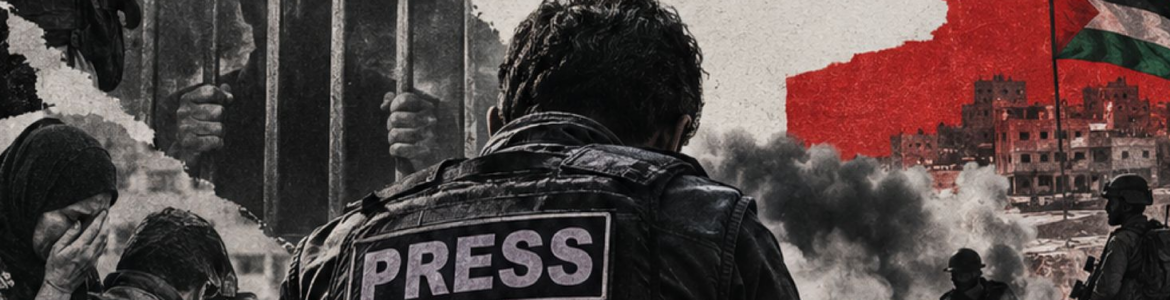
Clara Zid, November 2026
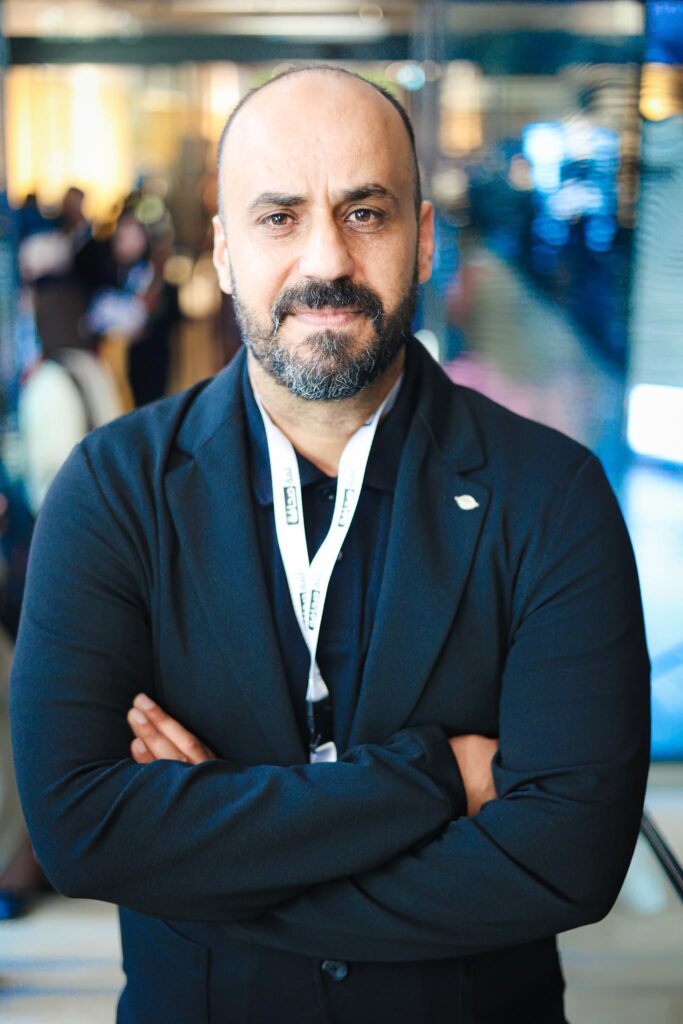
Mahmoud Hrebat discovered his passion for journalism while still in school, participating in radio broadcasts. Growing up in Palestine, he says, journalists were held in high regard, “much like sports or cultural icons”, because of their role in telling the Palestinian story.
Years later, this calling would take on a much deeper meaning.
The most deeply affecting moment in his career came when he waited for the body of his colleague Shireen Abu Akleh to arrive to Ramallah. Mahmoud was standing near the entrance of the Al Jazeera bureau when her body arrived.
“Shireen did not return walking on her own feet. She returned in a casket carried on shoulders, surrounded by chanting crowds.”
For Mahmoud, the scene marked a turning point. “It was a harrowing realization that we as journalists had suddenly transformed from reporters of the news into the news itself.”
That grief recurs today with every colleague killed in Gaza and the West Bank. And yet, he says, despite this heavy toll, “we remain committed to our calling.”
Reporting from Gaza
Mahmoud works as Executive Director of Lammet Sahafa (Journalists’ Gathering in English) and Palgraph, a journalistic school, media outlet and media forum based in Palestine. Since Israel declared war on Gaza in 2023, the organization’s workload has increased exponentially, forcing its team to focus increasingly on war reporting and documenting atrocities, says Mahmoud.
In the West Bank, where Lammet Sahafa is based, trainees and contributing journalists have faced military detentions, tear gas inhalation and rubber bullet injuries while reporting.
“Journalism in Gaza has become a daily life-and-death survival struggle”
Digital surveillance, harassment and physical targeting are usual. Moving through military checkpoints remains dangerous, often forcing journalists to conceal their credentials to avoid detention.
Lammet Sahafa maintains an active network of reporters and volunteers in Gaza. There, Mahmoud says, journalism has become a matter of “daily life-and-death survival”, characterized by direct military targeting, repeated displacement, severe equipment shortages and astronomical operational costs.
Many members of Mahmoud’s team have suffered forced displacements, lost their homes and family members. “Processing continuous trauma is profoundly challenging,” he says. Mahmoud himself regularly sees a mental health therapist. The pain and psychological pressure we absorb on a daily basis is immense, Mahmoud explains.
The team relies on each other. They have created a supportive working environment where people can speak openly about stress, grief, anxiety, anger… Human connections help interrupt the pressure of daily work. Sometimes, that means simply gathering for a shared meal.
Their security measures are equally practical. The most important is avoiding the deployment of staff into active high-risk military zones. This is complemented by strict digital security measures.
Shadow-banning on social media
For Mahmoud, however, the threats facing Palestinian media go far beyond the physical dangers of reporting from the ground.
Digital censorship has become a major obstacle, including systematic shadow-banning, algorithmic restrictions and content removal across social media platforms. Mahmoud says these are among the greatest structural challenges they face.
His own social media profiles have been restricted, while Lammet Sahafa’s institutional accounts have experienced stagnant audience growth.
The organization also faces frequent cyberattacks, bot-driven reporting campaigns and DDoS attacks, particularly during periods of intensified conflict.
That is why partnering with Qurium Media Foundation became, in Mahmoud’s words, “a critical strategic step” to secure hosting and protect their platforms against targeted cyber threats.
Journalism education in the field
The story of Lammet Sahafa began long before the current war.
It was a child of the Arab Spring, initially launched as a Facebook group in 2011 to support the Palestinian journalistic community. It soon expanded to WhatsApp, creating such a significant impact that it became the subject of research studies. In 2017, it transitioned into a formal NGO.
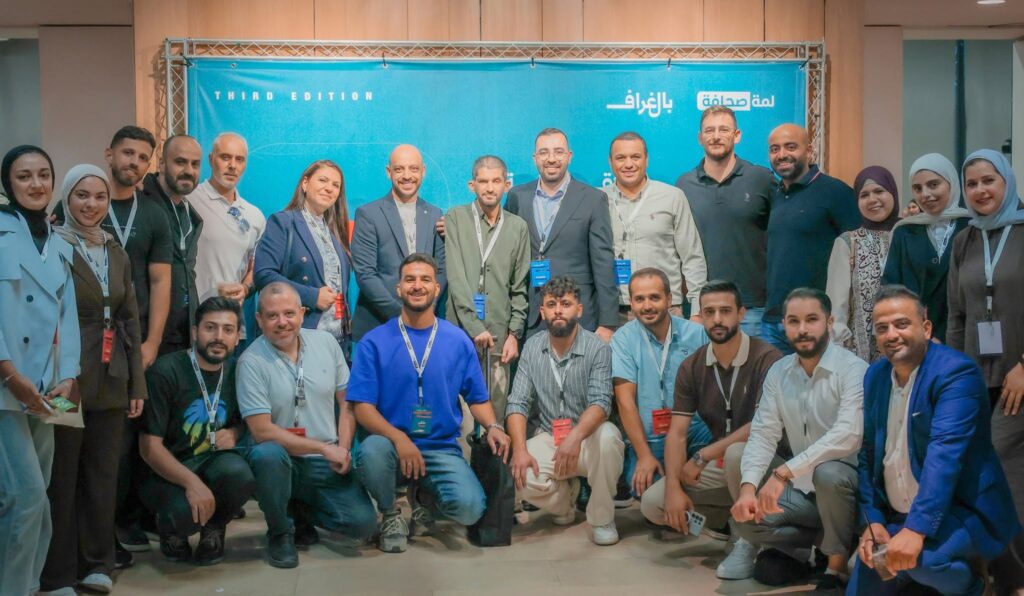
From the beginning, the idea was to connect journalism education with journalism in the field.
Lammet Sahafa brings academic learning and trainees produce journalistic content for the Palgraph platform, while the Lammet Sahafa network has become a collaborative digital hub where around 2,000 journalists share expertise.
“Practicing independent journalism in Palestine means navigating a minefield”
Palgraph focuses on podcasts, in-depth analytical reporting, human-interest stories and community success initiatives. In a media environment dominated by conflict and breaking news, they prioritize “slow, explanatory journalism that offers nuance and depth.”
Their primary audience is the local Palestinian community and Arabic-speaking audiences. But maintaining editorial independence comes with a price. Sometimes, Mahmoud says, it means turning down financial grants that come with political strings attached.
“Practicing independent journalism in Palestine means navigating a minefield,” he says. Pressure comes from multiple directions within society and “overarching all of this are the daily restrictions and suppression imposed by the Israeli occupation.”
Lammet Sahafa’s response is to train the next generation of journalists, more than 500 already, using a hybrid model that combines face-to-face workshops with online sessions, helping them overcome movement restrictions.
The next step will be an open digital learning platform.
“Reporting During Genocide”
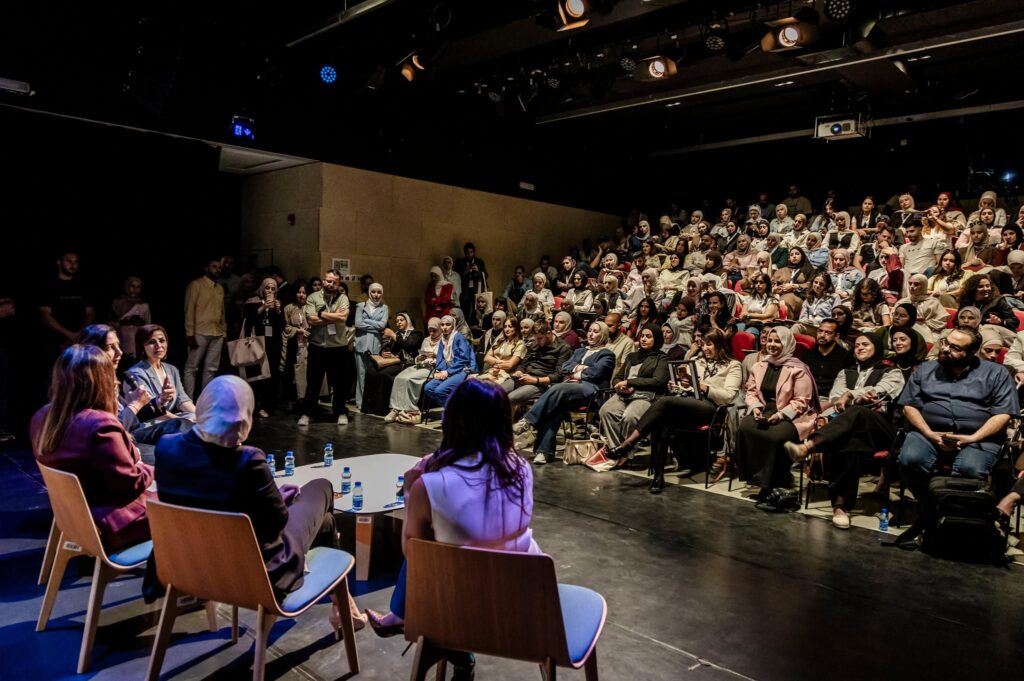
The national forum of Lammet Sahafa’s has become an important part of their work. The latest gathering brought together more than 700 journalists and media leaders. Through digital platforms and regional coordination, Lammet Sahafa was able to engage journalists across Palestine and the diaspora.
Among the topics discussed was “Reporting During Genocide”. The main consensus was the urgent need for a unified strategy of resilience, including the development of innovative models to survive severe funding cuts and physical threats.
For an organization working in such a volatile political environment, financial sustainability is another constant challenge.
Lammet Sahafa relies on institutional grants and self-generated revenue, while experimenting with reader-supported models such as micro-donations and subscription-based revenue. But complex local regulatory obstacles make this difficult.
“The reality is an ongoing occupation imposed by a dominant military power”
The organization has therefore participated in promoting reforms to the regulations governing non-profit organizations in Palestine. For Mahmoud, removing these administrative barriers is essential to creating an accessible environment, protecting editorial freedom and allowing organizations to manage independent funding.
All of this must be viewed within the context of a broader issue: how Palestine is understood internationally.
Mahmoud believes that the international audiences often treat what is happening in Palestine as a balanced conflict between two equal sides, when, in his view, “the reality is an ongoing occupation imposed by a dominant military power”.
He speaks plainly: “We are passing through a critical historical moment marked by an unprecedented humanitarian crisis.”
In such circumstances, Mahmoud sees independent journalism as an “essential safeguard for society”, with a role in ensuring accountability, documenting abuses for historical record, and advocating for human rights.
And, beyond all the issues regarding security, funding, digital attacks, and political pressure, there remains the reason why Mahmoud began this work in the first place.
A belief in “our right as Palestinians to tell our own story”.
Mahmoud remains committed to that calling.
Lammet Sahafa and Palgraph is hosted with Virtualroad.org since 2025.